Copper and Bronze in Art Corrosion Colorants Conservation Pdf
The conservation and restoration of copper and copper-alloy objects is the preservation and protection of objects of historical and personal value made from copper or copper alloy. When applied to items of cultural heritage, this activity is more often than not undertaken by a conservator-restorer.
Historically, objects made from copper or copper blend were created for religious, creative, technical, military, and domestic uses. The deed of conservation and restoration strives to prevent and slow the deterioration of the object as well as protecting the object for futurity use. The prevention and removal of surface dirt and corrosion products are the primary concerns of conservator-restorers when dealing with copper or copper-alloy objects.
History [edit]
Copper Age [edit]
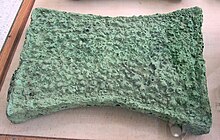
A corroded copper ingot from Zakros, Crete, shaped in the form of an animal skin typical in that era.
Copper occurs naturally every bit native copper and was known to some of the oldest civilizations on record. It has a history of use that is at least 10,000 years old, and estimates of its discovery place information technology at 9000 BC in the Center East;[1] a copper pendant was institute in northern Iraq that dates to 8700 BC.[2] There is evidence that gold and meteoric fe (merely not atomic number 26 smelting) were the just metals used by humans before copper.[3] The history of copper metallurgy is thought to have followed the post-obit sequence: 1) common cold working of native copper, 2) annealing, 3) smelting, and 4) the lost wax method. In southeastern Anatolia, all four of these metallurgical techniques appears more or less simultaneously at the beginning of the Neolithic c. 7500 BC.[4] However, only as agriculture was independently invented in several parts of the world (including Pakistan, People's republic of china, and the Americas) copper smelting was invented locally in several different places. It was probably discovered independently in China earlier 2800 BC, in Central America mayhap around 600 AD, and in West Africa about the 9th or tenth century Advertizement.[5] Investment casting was invented in 4500–4000 BC in Southeast Asia[1] and carbon dating has established mining at Alderley Border in Cheshire, U.k. at 2280 to 1890 BC.[6] Ötzi the Iceman, a male dated from 3300–3200 BC, was found with an axe with a copper head 99.7% pure; high levels of arsenic in his hair advise his involvement in copper smelting.[seven] Experience with copper has assisted the evolution of other metals; in item, copper smelting led to the discovery of iron smelting.[7] Production in the Old Copper Complex in Michigan and Wisconsin is dated between 6000 and 3000 BC.[viii] [9] Natural statuary, a type of copper made from ores rich in silicon, arsenic, and (rarely) can, came into general use in the Balkans effectually 5500 BC. Previously the only tool made of copper had been the awl, used for punching holes in leather and gouging out peg-holes for wood joining. However, the introduction of a more robust form of copper led to the widespread use, and large-scale production of heavy metal tools, including axes, adzes, and axe-adzes.[ citation needed ]
Statuary Age [edit]
Alloying copper with tin to make bronze was first skilful about 4000 years after the discovery of copper smelting, and about 2000 years afterwards "natural bronze" had come up into general utilize. Bronze artifacts from Sumerian cities and Egyptian artifacts of copper and bronze alloys date to 3000 BC.[10] The Bronze Age began in Southeastern Europe effectually 3700 - 3300 BC, in Northwestern Europe well-nigh 2500 BC. It concluded with the get-go of the Iron Age, 2000-1000 BC in the Near East, 600 BC in Northern Europe. The transition between the Neolithic catamenia and the Bronze Age was formerly termed the Chalcolithic period (copper-stone), with copper tools beingness used with stone tools. This term has gradually fallen out of favor considering in some parts of the world the Calcholithic and Neolithic are coterminous at both ends. Brass, an alloy of copper and zinc, is of much more recent origin. It was known to the Greeks, simply became a significant supplement to bronze during the Roman Empire.[ten]
Antiquity and Middle Ages [edit]

In alchemy the symbol for copper was also the symbol for the goddess and planet Venus.

In Greece, copper was known past the proper name chalkos (χαλκός). Information technology was an important resource for the Romans, Greeks and other aboriginal peoples. In Roman times, it was known every bit aes Cyprium, aes being the generic Latin term for copper alloys and Cyprium from Cyprus, where much copper was mined. The phrase was simplified to cuprum, hence the English copper. Aphrodite and Venus represented copper in mythology and alchemy, considering of its lustrous beauty, its aboriginal use in producing mirrors, and its association with Cyprus, which was sacred to the goddess. The vii heavenly bodies known to the ancients were associated with the seven metals known in antiquity, and Venus was assigned to copper.[11]
Britain's first utilize of brass occurred around the tertiary–2d century BC. In North America, copper mining began with marginal workings by Native Americans. Native copper is known to have been extracted from sites on Isle Royale with primitive stone tools between 800 and 1600.[12] Copper metallurgy was flourishing in Southward America, especially in Peru effectually 1000 Advertizing; information technology proceeded at a much slower rate on other continents. Copper burial ornamentals from the 15th century have been uncovered, but the metal's commercial production did not start until the early on 20th century.
The cultural office of copper has been of import, peculiarly in currency. Romans in the 6th through tertiary centuries BC used copper lumps as money. At first, the copper itself was valued, merely gradually the shape and look of the copper became more important. Julius Caesar had his ain coins made from contumely, while Octavianus Augustus Caesar'due south coins were made from Cu-Pb-Sn alloys. With an estimated almanac output of around 15,000 t, Roman copper mining and smelting activities reached a scale unsurpassed until the fourth dimension of the Industrial Revolution; the provinces most intensely mined were those of Hispania, Republic of cyprus and in Central Europe.[13] [14]
The gates of the Temple of Jerusalem used Corinthian statuary made by depletion gilding. It was most prevalent in Alexandria, where alchemy is thought to take begun.[fifteen] In aboriginal India, copper was used in the holistic medical scientific discipline Ayurveda for surgical instruments and other medical equipment. Ancient Egyptians (~2400 BC) used copper for sterilizing wounds and drinking water, and later on for headaches, burns, and itching. The Baghdad Bombardment, with copper cylinders soldered to lead, dates dorsum to 248 BC to Ad 226 and resembles a galvanic prison cell, leading people to believe this was the first battery; the merits has not been verified.[16]
Modern flow [edit]
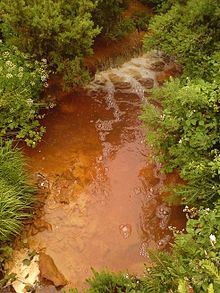
The Great Copper Mountain was a mine in Falun, Sweden, that operated from the 10th century to 1992. It produced two thirds of Europe's copper demand in the 17th century and helped fund many of Sweden's wars during that time.[17] It was referred to as the nation's treasury; Sweden had a copper backed currency.[18]
The uses of copper in fine art were not express to currency: it was used by Renaissance sculptors, in photographic technology known every bit the daguerreotype, and the Statue of Liberty. Copper plating and copper sheathing for ships' hulls was widespread; the ships of Christopher Columbus were among the earliest to accept this characteristic.[19] The Norddeutsche Affinerie in Hamburg was the first modern electroplating plant starting its production in 1876.[20] The German language scientist Gottfried Osann invented pulverisation metallurgy in 1830 while determining the metallic'due south diminutive mass; around so it was discovered that the amount and type of alloying element (e.g., tin) to copper would affect bell tones. Flash smelting was developed past Outokumpu in Republic of finland and first applied at Harjavalta in 1949; the energy-efficient process accounts for fifty% of the earth's primary copper production.[21]
The Intergovernmental Council of Copper Exporting Countries, formed in 1967 with Chile, Peru, Zaire and Zambia, played a similar part for copper as OPEC does for oil. It never achieved the same influence, particularly because the 2d-largest producer, the United States, was never a member; it was dissolved in 1988.[22]
Metallurgy [edit]
![[icon]](https://upload.wikimedia.org/wikipedia/commons/thumb/1/1c/Wiki_letter_w_cropped.svg/20px-Wiki_letter_w_cropped.svg.png) | This section is empty. You can help by adding to it. (Jan 2019) |
Corrosion [edit]
| | This section is empty. You can help past calculation to it. (July 2012) |
Conservation [edit]
Historical objects [edit]
Documentation [edit]
Systematic and well-managed documentation is today an essential prerequisite for quality executed conservation and restoration treatments, including documentation of the country of objects before, during and after treatment. Identification of materials and procedures used to produce object and the results of any scientific research must be function of documentation too. Final merely not least, an integral function of the documentation must be a recommendation for farther care of object.
Research [edit]
- identification of metals, alloys and metallic coatings
- identification of other organic/inorganic materials
- identification of corrosion products and processes
- identification of technology used to produce object
Conclusion making [edit]
In preparing the strategy of the metals conservation project interdisciplinary approach to the aforementioned is essential. It implies the participation of as many experts as is possible, every bit a minimum, we can have curator (archaeologist, historian, fine art historian), scientists specialized for corrosion of metallic objects of cultural heritage and the conservator - restorer
Cleaning [edit]
| Chemical | Electrochemical | Mechanical | Ultrasonic | Laser | Plasma |
|---|---|---|---|---|---|
| Ammonium citrate 5% / pH 9[23] Citric acid 20% + 4% thiourea[24] Phosphoric acid 10 - 20% + 1% thiourea[24] EDTA 4% pH 10[24] Potassium sodium tartarate 25% NaOH 120 g/40 m glycerol/1 L h2o[24] Polymethacrylic acrid 10-xv% pH 4.5 - five.5[25] | NaOH 2-5%, stainless steel anodes + Ecorr measurement! | Precipitated chalk/water mixture scalpel micromotor and steel/or bristle brushes microsanblasting unit dry water ice blasting | 4-6 g sodium carbonate /6-eight g sodium phosphate 10-12 yard sodium metasilicate 1 L distilled water ii–five minutes, then rinse well and repeat if needs | Tin can be used[26] [27] [28] | Tin be used[29] [30] |
Consolidation [edit]
Stabilization [edit]
- benzotriazole
Protective coatings [edit]
- clearcoats - Paraloid B-72 - Incralac - Ormocer - Everbrite Blanket - Pantarol A
- waxes - Renaissance Wax - Cosmolloid 80 H - Dinitrol 4010 - Poligen ES 91 009
- combinations - Paraloid B-72 + topcoat Renaissance Wax etc.
Archæology objects [edit]

Bronze Hui before and after conservation
Documentation [edit]
Research [edit]
Decision making [edit]
Cleaning [edit]
- mechanical
-Microsandblasting
-Dry ice blasting
-Scalpel or scraper
Loftier speed micromotor
-Steel or ceramic burs and cutters
-Abrasive wheels
-Wire brushes
-Glass fibre brushes and pens
-Setting hammer
Consolidation [edit]
Stabilization [edit]
- chloride removal
- corrosion inhibitors
-benzotriazole.[31]
-iv methyl imidazole[32]
-tannin[33]
-ammonium sulphide[34]
Protective coatings [edit]
- clearcoats - Paraloid B-72 - Incralac - Ormocer - Everbrite Coating - Pantarol A
- waxes - Renaissance Wax - Cosmolloid 80 H - Dinitrol 4010 - Poligen ES 91 009
- combinations - Paraloid B-72 + topcoat Renaissance Wax etc.
Preventive conservation [edit]
The items should be stored in rooms that are protected from polluted air, dust, ultraviolet radiations, and excessive relative humidity - ideal values are temperature of 16-20 °C and upwards to 40%(35-55% according to recent Canadian Conservation Institute recommendations) relative humidity, noting that if metallic is combined with organic materials, relative humidity should non be below 45%. Archaeological objects must be stored in rooms (or plastic boxes) with very depression relative humidity, or in the example of specially valuable items in the chambers with nitrogen or argon. Copper or copper alloy objects with active corrosion up to 35% RH. Shelves in the storerooms must be of stainless steel or chlorine and acetate costless plastic or powder coated steel. Woods and woods based products (particle lath, plywood) must be avoided. Besides do not utilise rubber, felt or wool. When y'all are handling metal objects, always wear clean cotton gloves . Lighting levels must be kept beneath 300 lux (up to 150 lux in example of lacquered or painted objects, up to l lux in instance of objects with light sensitive materials).
See also [edit]
- Conservation and restoration of metals
- Conservation and restoration of ferrous objects
- Conservation and restoration of glass objects
- Conservation and restoration of ivory objects
- Conservation and restoration of ceramic objects
- Conservation and restoration of silver objects
References [edit]
- ^ a b "CSA – Discovery Guides, A Brief History of Copper". Csa.com. Retrieved 2008-09-12 .
- ^ Rayner W. Hesse (2007). Jewelrymaking through History: an Encyclopedia. Greenwood Publishing Group. p. 56. ISBN0-313-33507-9.
- ^ "Copper". Elements.vanderkrogt.net. Retrieved 2008-09-12 .
- ^ Renfrew, Colin (1990). Before civilization: the radiocarbon revolution and prehistoric Europe. Penguin. ISBN978-0-xiv-013642-5 . Retrieved 21 December 2011.
- ^ Cowen, R. "Essays on Geology, History, and People, Chapter three: "Fire and Metals: Copper". Retrieved 2009-07-07 .
- ^ Timberlake, Due south. and Prag A.J.N.W. (2005). The Archæology of Alderley Edge: Survey, earthworks and experiment in an ancient mining landscape. Oxford: John and Erica Hedges Ltd. p. 396. doi:x.30861/9781841717159.
- ^ a b "CSA – Discovery Guides, A Cursory History of Copper". CSA Discovery Guides . Retrieved 29 April 2011.
- ^ Pleger, Thomas C. "A Brief Introduction to the Old Copper Complex of the Western Cracking Lakes: 4000–1000 BC", Proceedings of the Twenty-7th Almanac Meeting of the Woods History Association of Wisconsin, Oconto, Wisconsin, October 5, 2002, pp. x–18.
- ^ Emerson, Thomas E. and McElrath, Dale Fifty. Archaic Societies: Diversity and Complexity Across the Midcontinent, SUNY Press, 2009 ISBN i-4384-2701-8.
- ^ a b McNeil, Ian (2002). Encyclopaedia of the History of Technology. London ; New York: Routledge. pp. 13, 48–66. ISBN0-203-19211-seven.
- ^ Rickard, T. A. (1932). "The Nomenclature of Copper and its Alloys". Periodical of the Regal Anthropological Institute. Royal Anthropological Institute. 62: 281. doi:x.2307/2843960. JSTOR 2843960.
- ^ Martin, Susan R. (1995). "The State of Our Cognition About Ancient Copper Mining in Michigan". The Michigan Archaeologist. 41 (2–three): 119. Archived from the original on 2016-02-07. Retrieved 2012-12-11 .
- ^ Hong, S.; Candelone, J.-P.; Patterson, C. C.; Boutron, C. F. (1996). "History of Aboriginal Copper Smelting Pollution During Roman and Medieval Times Recorded in Greenland Ice". Science. 272 (5259): 246–249 (247f.). Bibcode:1996Sci...272..246H. doi:10.1126/scientific discipline.272.5259.246.
- ^ de Callataÿ, François (2005). "The Graeco-Roman Economy in the Super Long-Run: Lead, Copper, and Shipwrecks". Periodical of Roman Archeology. xviii: 361–372 (366–369).
- ^ Jacobson, D. M.; Warman, John M.; Barentsen, Helma 1000.; van Dijk, Marinus; Zuilhof, Han; Sudhölter, Ernst J. R. (2000). "Corinthian Bronze and the Golden of the Alchemists" (PDF). Macromolecules. 33 (two): sixty. Bibcode:2000MaMol..33...60S. doi:x.1021/ma9904870. Archived from the original (PDF) on 2007-09-29.
- ^ "Earth Mysteries – Strange Artifacts, Baghdad Bombardment". World-Mysteries.com. Archived from the original on v May 2011. Retrieved 22 April 2011.
- ^ Lynch, Martin (2004-04-fifteen). Mining in Earth History. p. 60. ISBN978-1-86189-173-0.
- ^ "Aureate: prices, facts, figures and research: A brief history of money". Retrieved 22 Apr 2011.
- ^ "Copper History". Retrieved 2008-09-04 .
- ^ Stelter, M.; Bombach, H. (2004). "Process Optimization in Copper Electrorefining". Advanced Engineering Materials. half-dozen (7): 558. doi:ten.1002/adem.200400403.
- ^ "Outokumpu Flash Smelting" (PDF). Outokumpu. p. 2. Archived from the original on July 24, 2011.
{{cite web}}: CS1 maint: bot: original URL condition unknown (link) - ^ Karen A. Mingst (1976). "Cooperation or illusion: an examination of the intergovernmental council of copper exporting countries". International Organisation. thirty (2): 263–287. doi:10.1017/S0020818300018270.
- ^ H.Brinch-Madsen, "Die reinigung von eisen mit ammoniakalischer Citronensaure", Arbeitsblatter fur Restauratoren two/1974
- ^ a b c d Stambolov, T.;Eichelmann, N.;Bleck, R.D. Korrosion u nd Konservierung von Kunst und Kulturgut aus Metall / I, Weimar 1987.
- ^ Nikitin, M.K.;Melynikova, Eastward.P. Himiya v restavracii, Leningrad 1990.
- ^ 1.Cooper, M.I. (2002) Laser cleaning of metal surfaces: an overview. Paper presented at the UKIC Metals Section 'Back to Basics: Surface Treatments' briefing (Liverpool, Oct 1999). Published in 'Back to Basics, The Metals Department' Press, 34-39.
- ^ Siano, S. The Gate of Paradise: concrete optimization of the light amplification by stimulated emission of radiation cleaning approach, Studies in Conservation 46/ 2001.
- ^ Drakaki, E. et al. Evaluation of laser cleaning of ancient Greek, Roman and Byzantine coins, Surface and Interface Assay, 42(half dozen-7), 671 - 674., 2010.
- ^ Saettone, E.A.O., Matta, J.A.Southward., Alva, W., Chubaci, J.F.O., Fantini, M.C.A., Galvão, R.Yard.O., Kiyohara, P. and Tabacniks, M.H., 2003. Plasma cleaning and analysis of archaeological artefacts from Sipán. Journal of Physics D: Practical Physics 36: 842-848. Accessed 13.02.2015.
- ^ http://www.plasmaconservation.cz/soubory/2012/prednaska-pppt-2012-krcma.ppt Accessed 13.02.2015.
- ^ Stambolov,T.;Bleck,R.D.;Eichelmann,N. Korrosion und Konservierung von Kunst und Kulturgut aus Metall,Weimar I/1987.,Two/1988
- ^ http://www.medal-project.eu/11-Copper_conservation.swf [ permanent dead link ]
- ^ Schemahanskaya,M.South.;Lemenovskiy,D.A.;Lomonosova,G.V.;Nesmeyanova,A.N.;Brusova,Grand.P Novie metodi v restavracii archeologicheskogo metala,Vestnik restavracii muzeinih cenostei 1/xi,Moscow 2008.
- ^ Belkin A.P.,Nackiy M.V. Metod obrabotki ochagov "bronzovoi bolezni" mednih splavov sulfidami amoniya//Restavracija pamjatnikov istorii i kulturi/GEL,Informkultura/Ekspres-informacija.Moscow,1987.Bp. iii. -Due south.vi-8
Farther reading [edit]
Books [edit]
- Selwyn, Fifty. Metals and Corrosion - A Handbook for the Conservation Professional person, Ottawa 2004.
- Scott, D.A. Metallography and Microstructure of Ancient and Historic Metals, Santa Monica 1991.(online)
- Scott, D.A. Ancient and Historic Metals - Conservation and Scientific Research, Santa Monica 1994.(online)
- Scott, D.A. Copper and Statuary in Art - Corrosion, Colorants, Conservation, Los Angeles 2002.(online)
- Cronyn, J.M. The Elements of Archaeological Conservation, London 1990.
- Rodgers, B. The Archaeologist Transmission for Conservation - A Guide to Not-toxic, Minimal Intervention Artifact Stabilization, New York 2004.
- La Niece,S. and Craddock,P. Metallic Plating and Patination: Cultural, Technical and Historical Developments, Boston 1993.
robertsonlaterfur1965.blogspot.com
Source: https://en.wikipedia.org/wiki/Conservation_and_restoration_of_copper-based_objects
0 Response to "Copper and Bronze in Art Corrosion Colorants Conservation Pdf"
Post a Comment