New York Asking Cps for a Review After Case Is Indicted
- Introduction
- Victims' Right to Review - Overview
- Eligibility
- Requesting a Review
- The Review Process
- Contacts
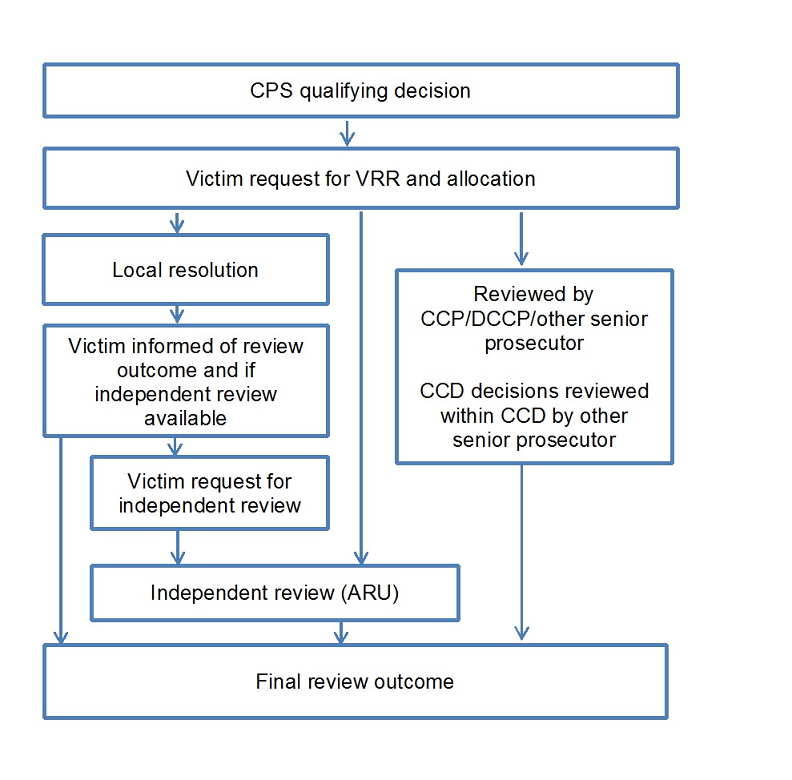
- Annex A - Review Process
- Annex B - Timeframes
- Annex C - Glossary of Terms
- Addendum D - Additional Resources - downloadable English and Welsh versions of this guidance and policy
Introduction
-
The Code for Crown Prosecutors gives guidance to prosecutors on the general principles to be applied when making decisions nearly prosecutions. Prosecutors must only kickoff or continue a prosecution when a case has passed both stages of the Full Code Test: (i) the evidential stage; followed past (ii) the public involvement stage.The Code makes clear information technology is not the office of the Crown Prosecution Service (CPS) to determine whether a person is guilty of a criminal offence, but to make assessments most whether it is appropriate to nowadays charges for the criminal courtroom to consider. The CPS cess of a example is not in whatever sense a finding of, or implication of, guilt or criminal conduct. A finding of guilt tin only be fabricated by a courtroom. Similarly, a determination not to bring criminal charges does not necessarily mean that an individual has non been a victim of crime. It is not the role of the CPS to make such determinations.
-
Information technology is instead the duty of prosecutors to make sure that the correct person is prosecuted for the right offence and to bring offenders to justice wherever possible. Casework decisions taken fairly, impartially and with integrity assist to secure justice for victims, witnesses, suspects, defendants and the public. Prosecutors must ensure that the law is properly applied, that relevant evidence is put before the court and that obligations of disclosure are complied with.
-
The Code for Crown Prosecutors sets out some broad definitions which are used in CPS casework and decision making. In summary:
- 'Victim' is used to draw a person confronting whom an offence has been committed, or the complainant in a case being considered or prosecuted by the CPS;
- 'Suspect' is used to describe a person who is under consideration every bit the subject of formal criminal proceedings;
- 'Accused' is used to describe a person who has been charged or summonsed; and
- 'Offender' is used to draw a person who has admitted guilt as to the commission of an offence, or who has been found guilty in a court of law.
-
Victims of offense and the public take a legitimate expectation that those who commit offences will exist brought to justice. This expectation and the rights of victims cannot exist overridden by a suspect's conventionalities that they will not exist prosecuted, including where the suspect has been told that there will not exist a prosecution or where a prosecution has been stopped. It is also of import that victims accept a right to seek a review of a determination not to prosecute, without having to seek recourse to judicial review proceedings in the first example.
-
The Victims' Right to Review (VRR) scheme enables victims to seek a review of certain CPS decisions not to starting time a prosecution or to cease a prosecution. It is an of import safeguard in England and Wales in relation to the rule of law. The scheme was launched in 2013 and gives outcome to the principles set out in the example of Killick (R v Christopher Killick [2011]). It is besides an entitlement included in the Lawmaking of Practice for Victims of Offense.
-
A request for review through the VRR scheme will usually be considered and completed past the appropriate local CPS office, or past CPS Direct (CPSD), where the original decision was made. A further review, independent to the local area, may be available through the CPS Appeals and Review Unit (ARU) inside the Special Crime and Counter Terrorism Sectionalization (SCCTD), where applicable. The ARU is a national CPS unit staffed with experienced prosecutors who comport an independent review of the cases referred to them.
-
This guidance sets out how the VRR scheme works, who tin can asking a review, what decisions can be reviewed, how to request a review and the stages of review. A diagram setting out the review process can be institute at Annex A, VRR timeframes at Annex B and a glossary of terms is included at Addendum C to aid analyze any legal terminology.
Victims' Right to Review - Overview
-
The VRR scheme provides a victim with a specifically designed process to practise the right to review sure CPS decisions not to starting time a prosecution or to stop a prosecution. If a new conclusion is required, it may be appropriate to establish or reinstitute criminal proceedings.
-
The right to asking a review of a determination non to prosecute under the VRR scheme applies to decisions that have the effect of beingness terminal made past every Crown Prosecutor, regardless of their grade or position in the arrangement. It is important to note that the "right" referred to in the context of the VRR scheme is the right to request a review of a concluding decision. It is not a guarantee that proceedings will exist instituted or reinstituted.
-
Occasionally in that location are cases where the CPS volition overturn a decision not to prosecute or to deal with the case by way of an out-of-court disposal or when it will restart the prosecution. These cases include:
- cases where a further review of the original conclusion shows that it was wrong and, in order to maintain conviction in the criminal justice system, a prosecution should be brought despite the before decision;
- cases which are stopped and then that further anticipated testify, which is probable to go available in the fairly about hereafter, can be collected and prepared. In these cases, the prosecutor volition tell the accused that the prosecution may well get-go once again;
- cases which are non prosecuted or are stopped because of a lack of evidence simply where more than significant evidence is discovered later; and
- cases involving a death in which a review post-obit the findings of an inquest concludes that a prosecution should be brought, yet any earlier decision not to prosecute.
Further, non-exhaustive, examples of cases that are reinstituted, and what might constitute a 'wrong decision' can exist found in the Reconsidering a Prosecution Decision policy.
-
Prosecutors must comply with whatsoever guidelines issued by the Attorney General and with the policies and guidance of the CPS issued on behalf of the Director of Public Prosecutions, unless it is determined that in that location are expert reasons or exceptional circumstances to depart from a policy statement in an individual case.one
Potential review outcomes
-
Following a review under the scheme, qualifying decisions non to charge, to discontinue, and to withdraw tin be instituted or reinstituted, subject to any statutory fourth dimension limits. There are two possible review outcomes:
- A New Conclusion: when the before decision is overturned - see paragraph 10 above for some examples of circumstances where the CPS will overturn a decision non to prosecute or when information technology volition reinstitute the prosecution.
- Uphold Previous Decision: the original decision not to prosecute is upheld, and the victim notified and provided with an explanation.
-
Where the CPS qualifying conclusion has asked the Crown Court to allow all charges in a example to 'lie on the fileii and the court has then ordered, these cases cannot be reinstituted without the get out of the Crown Court or the Court of Entreatment. In the context of a VRR review, while these qualifying decisions volition nonetheless be reviewed nether the scheme, unless a significant change in circumstances has taken identify since the gild was made it is highly unlikely that a court volition grant exit to reinstitute. Redress is therefore likely to exist limited to an caption and apology where the original decision is found to have been wrong.
-
Some qualifying decisions cannot be instituted or reinstituted, such as 'offering no evidence' decisions and cases which go statute barred.three This is because such decisions are concluding, and proceedings cannot be reinstituted; again, redress in these circumstances is limited to an explanation and apology.
-
It is important to note that although such cases cannot be instituted or reinstituted, the quality and thoroughness of the review undertaken volition be no less than a review undertaken for any other category of case. The important upshot being addressed in these cases is whether the original qualifying decision was wrong.
Eligibility
Victims
-
'Criminal acquit' is behaviour constituting a law-breaking under the National Crime Recording Standard. A victim for the purposes of the VRR scheme is defined as follows:
'a person who has fabricated an allegation that they have suffered impairment, including concrete, mental or emotional harm or economic loss which was direct caused by criminal conduct'.
The telescopic of those affected, and divers every bit a victim, can include:
- shut relatives of a person whose decease was directly caused by criminal conduct;
- parents or guardians where the chief victim is a child or youth nether eighteen;iv
- police force officers who are victims of criminal offense;
- family unit spokespersons of victims with a inability or who are and so badly injured they cannot communicate; and
- businesses, providing they give a named point of contact.
-
There are no age restrictions in respect of those entitled to seek a review under the VRR scheme. All the same, if someone wishes to submit a request for review on behalf of a victim and they do non autumn within one of the definitions listed above, written confirmation that they have the authorization of the victim to act on their behalf must be provided.
Decisions
-
The correct to request a review under the VRR scheme arises where the CPS:
- makes a final decision not to bring proceedings (i.due east. at the pre-charge stage)
- discontinues or withdraws all charges5 involving the victim, thereby entirely ending all proceedings relating to them;
- has offered no evidence in all proceedings relating to the victim; or
- asks the court to leave all charges in the proceedings to 'lie on the file'.
These are known as 'qualifying decisions' and are decisions that take the issue of being last.
-
Decisions that are non eligible for VRR include:
- where the qualifying decision was fabricated prior to 5 June 2013;
- where the CPS has not made a decision that has the consequence of beingness concluding at the pre-accuse stage;
- where the police or other investigator exercises their independent discretion non to investigate or non to investigate a case further (whether in consultation with the CPS or not) and the CPS have not been requested / have been unable to brand a last determination to charge. Requests for review of such decisions should instead be addressed to the relevant police force/other investigator;
- where charges are brought in respect of some (but not all) allegations fabricated or against some (but not all) possible suspects;
- where a unmarried charge or charges are terminated6 but another charge or charges relating to that victim go on;
- where proceedings against one (or more) defendants are terminated but proceedings (relating to that victim) against other defendants keep;
- where a unmarried charge or charges are essentially altered but proceedings involving that victim go along;
- cases where some (simply non all) charges are left to lie on the file;
- cases which are concluded by way of out of court disposalseven;
- cases where the victim requests that proceedings exist stopped or withdraws support for the prosecution and a decision is therefore taken non to charge/to terminate proceedings. If a victim does not attend court to give evidence when required and without providing reasonable notice, and a prosecution can no longer continue, this can exist inferred as withdrawing support for the prosecution unless there are exceptional circumstances; and
- cases which are brought to an cease in circumstances where the prosecution may have a correct of entreatment8 or where a decision is made non to oppose an awarding to dismiss charges pursuant to Rule 9.16 of the Criminal Procedure Rules 2015.
VRR is likewise not available in cases where the Director of Public Prosecutions personal decision is required past law.
-
Cases which are not charged or are stopped and take the effect of being final decisions due to outstanding inquiries or information or material that has been requested from the investigator by the prosecutor but not received, can exist subject to review under the VRR scheme simply is limited to the local resolution phase (please encounter paragraph forty beneath for more than information on local resolution). Such cases may be reinstituted, in accord with the 'Reconsidering a Prosecution Decision' policy, should the cloth become available during the local resolution stage review and if the Full Lawmaking test is then met. If the material becomes available during this review, only the Area still upholds the original decision for further evidential or public interest reasons, only and then will the decision become eligible for contained review by the ARU.
Date of decision
-
The VRR scheme is not retrospective in its awarding and volition merely exist applied to cases in which the qualifying decision was made on or later on the 5 June 2013 (the date the VRR scheme was launched).
-
Dissever arrangements are in place for decisions made before five June 2013 in relation to allegations of child sexual abuse. In such cases, the Kid Sexual Abuse Review Panel looks again at cases where a person has fabricated previous allegations of being a victim of a sexual offence when they were nether the age of 18, and the police or CPS decided that no action should be taken at the time. If the decision in relation to allegations of kid sexual abuse was taken on or after 5 June 2013, a review can exist requested under the VRR scheme. Further information is available at the Child Sexual Abuse Review Panel page, on the CPS website.
Complaints
-
If it is considered that the request for review does non fall within the telescopic of the VRR scheme, it may be more than appropriate to handle the request every bit a complaint, and in line with the CPS Feedback and Complaints policy. At that place is a six-month fourth dimension limit for bringing a complaint nether the policy in all simply the virtually exceptional circumstances. Complaints should e'er exist managed at the local CPS office or CPSD, and not referred to ARU, unless the complaint relates to the ARU handling of the instance.
-
If some elements of the victim'due south request establish a complaint, while other elements autumn within scope of the VRR scheme, information technology will not always be necessary to await the effect of the review under the VRR scheme for the complaint to be considered and a response provided. Nevertheless, if at that place is an overlap, and it is assessed that the VRR must be completed first, the victim will be informed that the matter beingness dealt with as a complaint volition be addressed at the end of the VRR process.
Private Prosecutions
-
Where the CPS deems that a VRR is available in respect of a qualifying determination made in accord with the CPS Private Prosecutions policy (e.m. where a prosecution has been taken over past the CPS and discontinued or stopped), the independent review volition exist based on the fabric that was provided to the prosecutor who fabricated the original qualifying determination. However, the reviewing prosecutor retains the right to request more textile, as considered necessary.
Requesting a Review
How and when to request a review
-
Victims volition be notified of the prosecution decision not to bring proceedings/bring proceedings to an terminate. Where an investigator is responsible for notifying a victim of a conclusion not to bring proceedings, the investigator volition suggest the victim of their right to review on behalf of the CPS. This notification volition include the following information:
- the nature of the decision - i.eastward. not to charge or to discontinue proceedings; and
- whether the decision was fabricated on evidential or public interest or other grounds.
-
If the decision is a 'qualifying decision' (divers in a higher place at paragraph 18), the notification will confirm that the victim is eligible to seek a review under the VRR scheme and will provide sufficient information to enable the victim to determine whether or not they wish a review to have place, and if so, what steps they need to take. Any person wishing to request a review of a decision, merely who is unsure of how to do so, should contact their local CPS office for further information.
-
There is no requirement for a victim to seek legal advice or representation or to provide reasons for requesting a review. The only activeness a victim need accept is to notify the CPS of their request for review, inside the agreed time frame. Whatever representations which are made will be considered simply should be submitted within 14 days of the request for review. Victims will exist provided with contact details of the relevant CPS part in order that they can make contact by their preferred ways.
-
Suspects are not routinely informed that a asking has been made for review under the VRR scheme. This is to preserve confidentially for a victim as the doubtable will have been released from any bail conditions or obligations. Even so, suspects should have been informed by the constabulary that a prosecution may still exist brought if further evidence or information comes to light, or if the decision is reconsidered by a Crown Prosecutor who determines that a new decision is required.
Timeframes
-
A request for a review should usually exist made within 10 working days of the date of the decision alphabetic character. Requests may exist submitted after 10 working days, although a filibuster may impact negatively on the outcome of the conclusion-making process. Furthermore, requests made more than three months after the qualifying decision was communicated are unlikely to be accepted unless there are exceptional circumstances. While not an exhaustive list, exceptional circumstances may include when a victim has non been notified of their right to review, or has been given incorrect information about the timeframes.
-
The CPS will, wherever possible, consummate the review and communicate the decision to the victim inside an overall review timeframe of xxx working days. In cases where it is not possible to provide a VRR decision inside the usual timeframes, for instance in more complex cases, the CPS will notify the victim accordingly. Regular updates will be provided as to the progress of the review, although these will not be more frequent than every 20 working days thereafter, until a final decision is made. A summary of these timeframes tin can be establish at Annex B.
-
Where a case is due to become statute-barred before the VRR menstruum expires, the CPS volition aim to expedite the VRR process and provide a decision within the statutory time menses, if possible. The engagement when the case will become statute barred will be identified and communicated to the victim when the qualifying decision is communicated so that the deadline is clear. It should exist noted that where a case is referred for review on a date close to the expiry of the statutory time limit, it may not always exist possible for a review to exist completed within the time limit for bringing a prosecution.
Meeting with Victims
-
In some circumstances, victims are entitled to request a coming together with their local CPS office or CPSD to hash out a qualifying decision, before requesting a review under the VRR scheme. This can include cases involving sexual offences, cases where deaths have occurred and cases involving hate crimes. A meeting can sometimes help a victim to improve empathize the decision making procedure and the reasons for a conclusion, and volition negate the requirement for a review nether the VRR scheme. However, there are circumstances where a meeting may not be advisable or helpful. If the Prosecutor is of the view that a meeting is not appropriate at that stage, for example, where a review nether the VRR scheme has already been requested or is anticipated, the reasons should be explained to victim and if possible any meeting deferred until afterward the VRR has been completed, if still required.
-
This is because at that place are limitations around what can be discussed at a meeting with victims before a review nether the VRR scheme has been completed. For example, discussing testify in a case could be prejudicial, should the conclusion after be overturned following a review under the VRR scheme. These limitations can prevent any further meaningful information being provided. A meeting after a review under the VRR scheme has been completed is probable to be more than beneficial to a victim, when restrictions around what tin can be openly discussed have fallen away.
-
If a victim requests a meeting before requesting a VRR, they should exist advised that if they are considering a asking for review under the VRR scheme, any meeting should exist deferred until afterwards the VRR has been completed. One time a review under the VRR scheme has been completed any meeting should be conducted by the local CPS function or CPSD that fabricated the original determination.
The Review Process
-
The VRR scheme can include two stages of review:
- firstly, a local resolution stage where reviews are conducted past a new prosecutor at the appropriate local CPS office or CPSD where the original decision was made;9
- secondly, (if the original decision not to prosecute is upheld), if eligible, a review contained from the local CPS part where the original decision was made, conducted by the ARU.
If the original decision was fabricated past a prosecutor in a Cardinal Casework Partition (CCD) a review will be conducted by another prosecutor in the CCD with no previous interest in the case, or another suitably qualified prosecutor who has the necessary specialist knowledge.
A process diagram can be establish at Annex A.
-
The type of qualifying decision being reviewed and the original decision maker will determine the correct review pathway. The table below provides a summary and sets out the respective review.
Qualifying Decision Decision Maker Review - Not to accuse;
- Discontinue;
- Withdraw; or
- Lie on the file.
Main Crown Prosecutors10
Straight to Independent Review by ARU.
Central Casework Divisions
Most reviews will be handled within the Cardinal Casework Partition, with no onward ARU review. The Head of Sectionalization may engage a prosecutor (usually) from their ain Sectionalisation who has not been involved in the original decision. No local resolution stage.
Area CPS Prosecutors
Local Resolution, so Independent Review by ARU (unless conditions at paragraph 20 apply and Independent Review is not available).
- To offer no evidence; or
- If the statutory time limit has expired.
Principal Crown Prosecutors
Allocated to another senior prosecutor within CPS who was not involved in original determination, with no onward ARU review.
Cardinal Casework Divisions
Most reviews will be handled within the Central Casework Partitioning, with no onward ARU review. The Head of Division may appoint a prosecutor (ordinarily) from their ain Partition who has not been involved in the original decision.
Surface area CPS Prosecutors
Master Crown Prosecutor
Deputy Chief Crown Prosecutor.
-
In accordance with established CPS policies, if a case is of a nature whereby, decisions are to be taken by specialists in a particular legal field (eastward.thou. rape and serious sexual offences) the review will also be conducted past a relevant specialist.
-
Any qualifying decision taken past a CPS Director of Legal Services (DLS) will normally be referred directly to some other DLS who has not been involved in the original decision, for review. In addition, at that place may exceptionally be particularly sensitive or complex VRR cases where the DLS or Director of Public Prosecutions (DPP) are consulted by the Head of SCCTD or where they inquire to be consulted or to undertake the independent review, at their discretion and in accordance with our established determination making arrangements. To ensure the independence of review, this can only happen if the DLS and/or DPP has had no involvement in the initial determination. There is no right for a victim to request a review past the DLS or the Director of Public Prosecutions.
Local Resolution
-
At the local resolution stage, for qualifying decisions non to charge, discontinue, withdraw or lie on the file, the local CPS role or CPSD should assign a new prosecutor, not previously involved in the original qualifying decision, to conduct the local resolution review.
-
If the review outcome at this stage is that proceedings should exist instituted or reinstituted, appropriate procedures will be followed and the victim updated.
-
If the review outcome is to uphold the original determination not to prosecute, the victim will be provided with boosted information or a farther explanation, and brash that if they remain dissatisfied with the decision they should contact the ARU to request an independent review.11 Contact details volition exist provided together with guidance every bit to how to continue, should they wish to. Victims should brand this request inside 10 working days from receipt of the local resolution review decision. Once the independent review has been finalised, the victim will be given a total caption of the decision.
-
For qualifying decisions to offer no evidence, the review should exist conducted by a CCP or a Deputy Master Crown Prosecutor (DCCP) within the local CPS part. If the 'offering no testify' qualifying decision was originally made by a CCP, the review should be allocated to some other senior prosecutor within CPS who was non involved in original determination. The same arroyo should be taken with cases which go statute barred subsequently a qualifying decision has been made but before a review is requested or completed. In these circumstances, there is no further review by the ARU.
Review of CCD cases
-
Where a decision has been taken within a CCD, a review will be conducted past some other CCD prosecutor who has not been involved in the original conclusion or another suitably qualified prosecutor who has the necessary specialist knowledge.
-
This different organization is necessary because the nature of the prosecutions undertaken in the CCDs may mean that in most cases a prosecutor with experience of the particular specialism in question would exist all-time placed to conduct the review. Post-obit a review within the CCD, at that place is no further review by the ARU.
Change in circumstances
-
When a new determination is taken following review under the VRR scheme, and a prosecution has been instituted or reinstituted, the prosecution may only exist later on stopped exceptionally if there is a alter of circumstances in the case, for example where new evidence or a loss of testify ways that the Full Lawmaking Test is no longer met. If such circumstances arise, the case volition be referred dorsum to the ARU (unless impracticable, eastward.thou. during a trial) to consider whether to stop the prosecution. If the ARU decide to stop the prosecution, there is no recourse to a further review under the VRR scheme.
Judicial review
-
Following the determination of the VRR process, at that place is no scope for whatever farther review past the CPS. If the victim remains dissatisfied with the determination, and/or wishes to claiming it farther, then the victim should consider the merits of applying to the High Court for a judicial review of the decision. There is likely to exist an expectation that a review under the VRR scheme will take been exercised before any judicial review of a qualifying determination is commenced.
Contacts
-
If anyone would like to ask a question nearly the VRR scheme, in the first example they should contact the CPS Area function where the original qualifying decision was fabricated. The contact details will have been provided when the CPS informed you that the conclusion had been made. If you do not have these details, delight visit the CPS website'south Contacts section.
-
The CPS public research helpdesk can provide general information nearly the CPS and advice on who to contact if y'all have a specific query. The squad cannot give legal communication, but may exist able to provide practical information. Please exercise not contact the public enquiry helpdesk nearly specific cases. You can contact the public enquiry helpdesk on:
Phone: 020 3357 0899
Email: enquiries@cps.gov.great britainCPS Public Enquiries
102 Petty France
London
SW1H 9EA
Annex A - Review Process
The type of qualifying decision being reviewed and the original decision maker will determine the right review pathway.
Addendum B - Timeframes
A broad summary of related VRR timeframes tin can exist plant below. Please refer to paragraphs 30-32 for more data.
| Stage | Timescale |
|---|---|
| Victim request for review | Submitted within ten working days of the date of the conclusion letter. |
| Local resolution | Completed within ten working days of receiving a request for review. |
| Victim request for independent review (where available) | Within 10 working days from receipt of the local resolution review decision. |
| Contained review | Completed inside 20 working days of receiving a request for review. |
| Communicate last review issue | The CPS will, wherever possible, complete the review and communicate the conclusion to the victim inside an overall review timeframe of thirty working days. |
For cases which are reviewed by a CCP, DCCP or other senior prosecutor or where CCD decisions are reviewed within a CCD by another senior prosecutor, a review will be completed within 30 working days.
In all cases where information technology is not possible to provide a VRR decision within the usual timeframes, for example in more circuitous cases, the CPS will notify the victim accordingly. Regular updates will be provided as to the progress of the review, although these will non be more frequent than every 20 working days thereafter, until a terminal determination is made.
Annex C - Glossary of Terms
| ARU | Appeals and Review Unit. |
| CCD | Key Casework Division. |
| CCP | Chief Crown Prosecutor. |
| CPS | Crown Prosecution Service. |
| DCCP | Deputy Chief Crown Prosecutor. |
| Decision not to charge | When a prosecutor has decided that a person should not be charged with a criminal offence, in accordance with the Lawmaking for Crown Prosecutors. |
| Decision to discontinue | Sections 23 and 23A of the Prosecution of Offences Deed 1985 requite prosecutors the ability to discontinue or finish proceedings. |
| Decision to prevarication on file | In the Crown Court the estimate has the ability to lodge that entire indictments or some counts on an indictment to 'lie on the file'. At that place is no verdict, so the proceedings are not formally terminated. There can be no farther proceedings against the defendant on those matters, without the go out of the Crown Court or the Court of Appeal. |
| Determination to withdraw | To withdraw a charge at a Magistrates court. Offences tin can be withdrawn by the prosecutor in the Magistrates' court (but) at any time before adjudication past the courtroom. |
| Contained Review | A review, independent to the local CPS area office, conducted by CPS Appeals and Review Unit (ARU). |
| Constitute | To brainstorm a prosecution if a prosecution has not previously commenced. |
| Local Resolution | Local review phase, considered and completed past the appropriate local CPS role, or CPS Direct (CPSD) where the original decision was fabricated. |
| Offer no bear witness | A prosecutor may offer no evidence in either Magistrates' Court or Crown Court proceedings and the effect will be the acquittal of the defendant. |
| Qualifying Decisions | Decisions eligible for review under VRR. |
| Reinstitute | To re-start a prosecution if a prosecution had previously commenced. |
| Statute Barred | An offence where the statutory time limit for bringing criminal proceedings has expired and it is no longer possible for a person to be prosecuted for that offence. Offences which carry a statutory time limit are usually less serious offences in which criminal proceedings must be commenced inside 6 months of the date of the offence. |
| VRR | Victims' Correct to Review. |
Annex D - Additional Resources
PDF versions of the guidance contained on this folio can be downloaded below, available in English and Welsh.
Detailed Guidance on VRR:
Victims' Right to Review Guidance and Policy, May 2021 Revision (PDF document, 312kb)
Ganllawiau manwl ar VRR:
Ganllaw a Pholisi Hawl Dioddefwyr i Adolygu (diwygiwyd Mai 2021) (Dogfen PDF, 169kb)
robertsonlaterfur1965.blogspot.com
Source: https://www.cps.gov.uk/legal-guidance/victims-right-review-scheme
0 Response to "New York Asking Cps for a Review After Case Is Indicted"
Post a Comment